Apple · Autonomous vehicle program · Internal AV tooling
2016 – 2019
Autonomous
Vehicle Tooling
Internal tooling for AV scenario visualization, data pipeline monitoring, and workflow management — for ~100 engineers, operators, and drivers.
Client
Apple
Role
Senior UX Designer (Sole)
Users
~100 engineers, operators, drivers
Tools
Sketch · Qt · Sublime · C++ · CSS/QSS · Illustrator
01
The Program
From 2016 to 2019 I designed the internal tooling infrastructure for Apple's autonomous vehicle program — the software that engineers, operators, and test drivers used every day. No prior design patterns existed. Each tool was designed from scratch, shipped iteratively, and refined through embedded collaboration with the engineering teams who built them.
The work covered three primary systems: a 3D scenario visualizer for reviewing map and sensor data, a data pipeline dashboard for monitoring collection campaigns, and a task dependency graph for managing acquisition workflows.
02
Tool 01 · 18 months
3D Scenario Visualizer
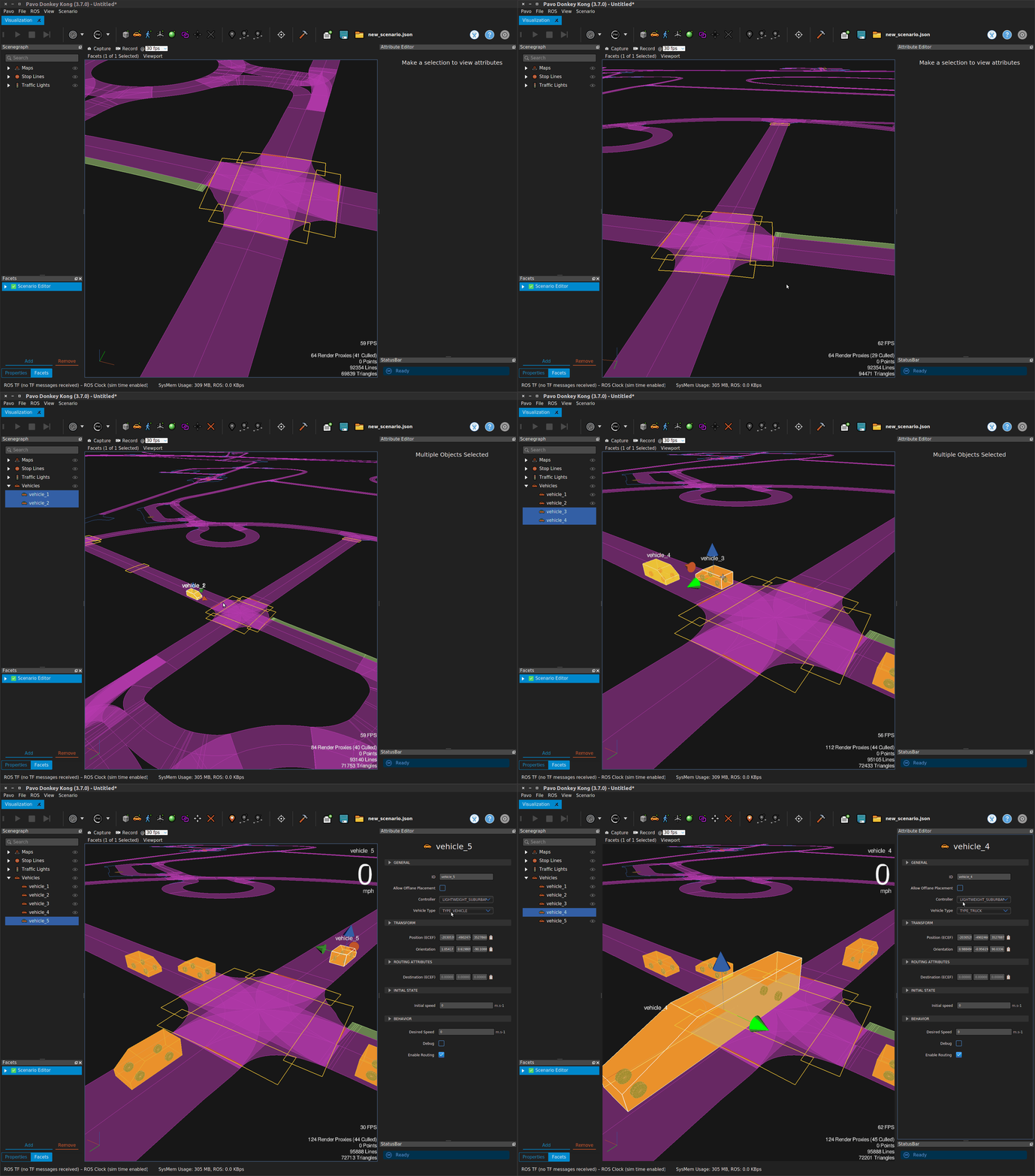
AV scenario visualization — maps, stop lines, traffic lights, moving assets
A 3D visualization tool running on Linux and Mac via Qt — used by engineers and operators to build, inspect, and replay AV scenarios. Renders maps, stop lines, traffic signals, and moving assets with configurable scene graph and attribute inspector.
03
Tool 02 · 12 months
Data Pipeline Dashboard
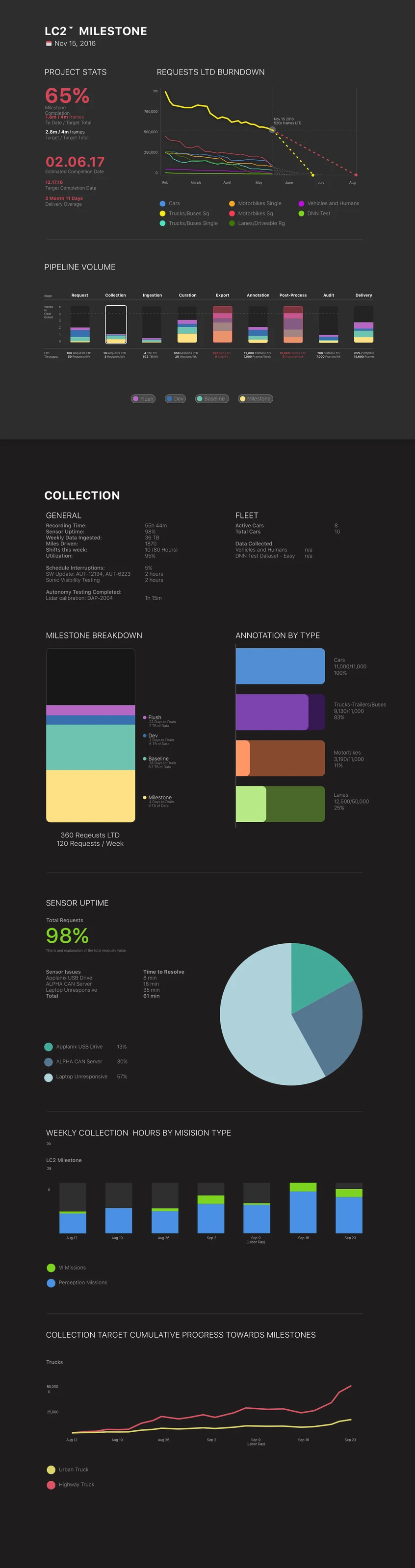
LC2 milestone dashboard — sensor data pipeline status
Dashboard for monitoring AV data collection campaigns — sensor pipeline status, milestone tracking, and multi-vehicle run overview. The tool saved 8–12 hours per person per week over the prior command-line workflow.
04
Tool 03 · 6 months
Task Dependency Graph
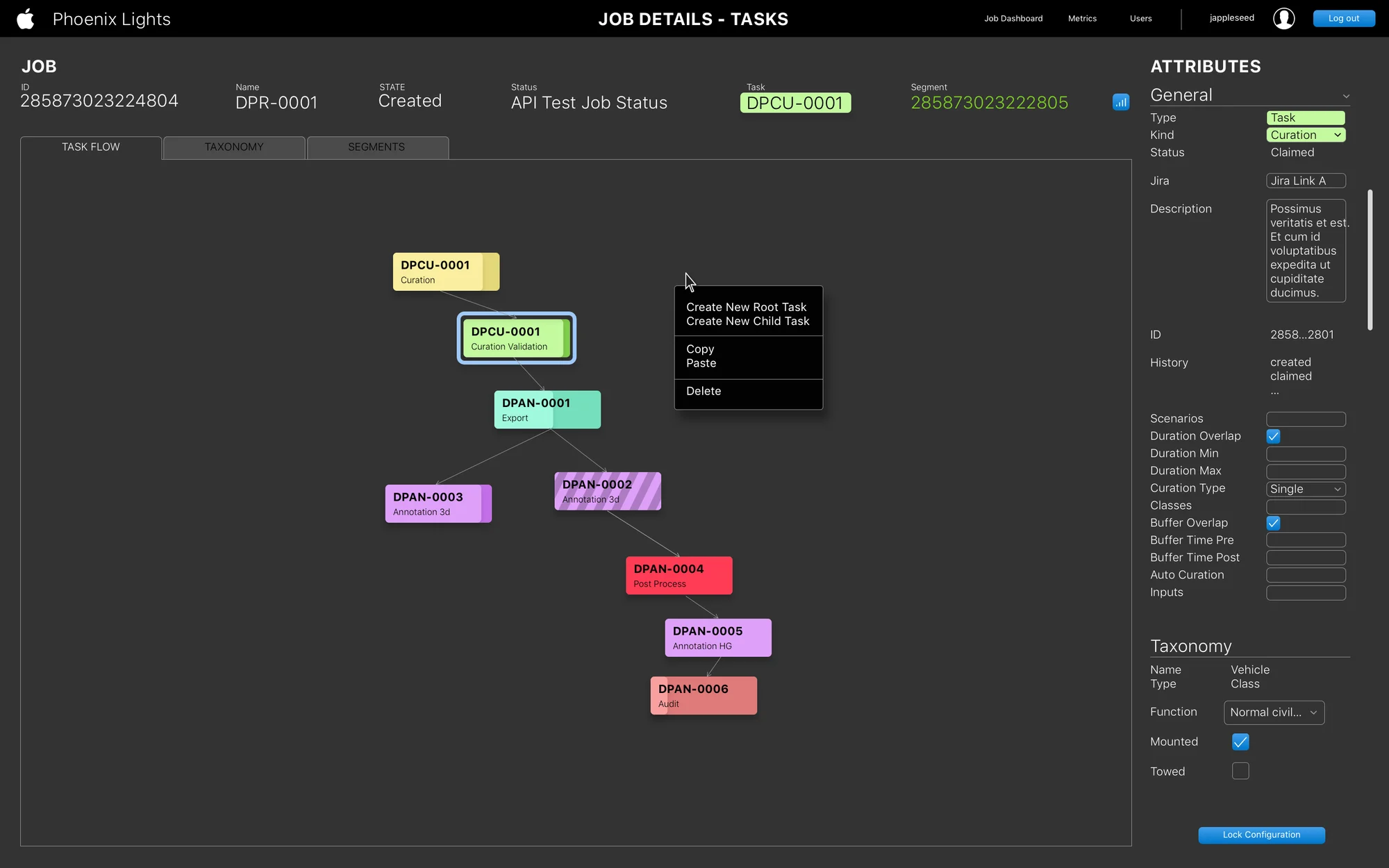
Phoenix Lights — task dependency node graph
Task and validation management tool for the AV data acquisition team. The tool visualizes and replaces a spreadsheet-based dependency model. Leads configure complex dependencies in a node-based editor, with user profiles, team management, and segment claim assignment all on a single interface.
05
Outcomes
6
Applications
Six related internal applications sharing IA, tables, dialogs, and 3D affordances where applicable.
~100
Users
Peak user footprint on the Qt visualization program (internal distribution).
4–6h
Time reclaimed / week
Task-management program: internal study on team leads consolidating off-task tools into one workflow.
Pattern Library
Components, layouts, and usage notes so engineering could implement without guesswork.
Contribution Guide
How to propose, review, and retire patterns so the system stayed maintainable.
Critique Cadence
Weekly reviews with embedded partners to align on edge cases before they spread.
Next project
DreamWorks — Production PlatformEnterprise UX